Every claim decision, provably on the record.
Captive management for group and single-parent captives. Policies, premiums, claims, member voting and dual-controlled payouts — on an append-only audit trail that is cryptographically anchored, so what happened is a matter of proof rather than trust in a database.
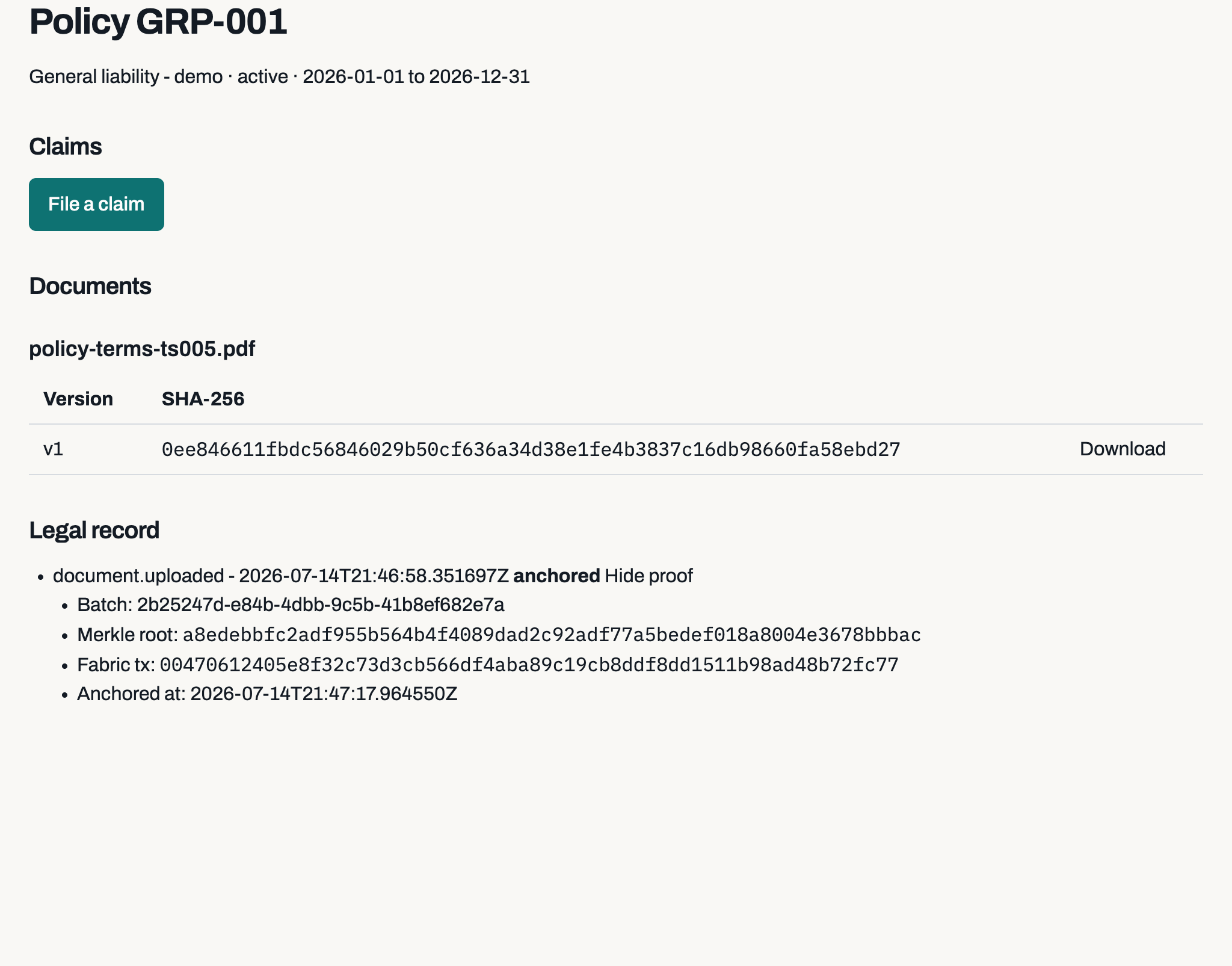
Request a demoanchored · batch 2b25247d-e84b-4dbb-9c5b-41b8ef682e7a · merkle a8edebbfc2adf955b564b4f4089dad2c92adf77a5bedef018a8004e3678bbbac · fabric tx 00470612405e8f32c73d3cb566df4aba89c19cb8ddf8dd1511b98ad48b72fc77
Your members fund the payout. They will ask.
In a group captive, every claim you pay comes out of a surplus the members own. That makes claims decisions political in a way they never are at a commercial carrier: the people you are adjudicating for are the people funding the cheque.
Six months later, when one member asks why their loss was denied and another's was paid, what do you actually have? Rows in a database. A modification timestamp that anyone holding the credentials could have set. An audit log written by the same application it is meant to be auditing.
That is fine right until it isn't — a coverage dispute, a domicile exam, a member heading for the exit. Then our system says so has to carry weight it was never built to carry.
What you can hand over
Not a report the system generates about itself. Evidence that stands up when someone disputes it.
| What happened | What you can produce |
|---|---|
| A policy document was issued | Its SHA-256, and the ledger transaction that fixed that hash in time. |
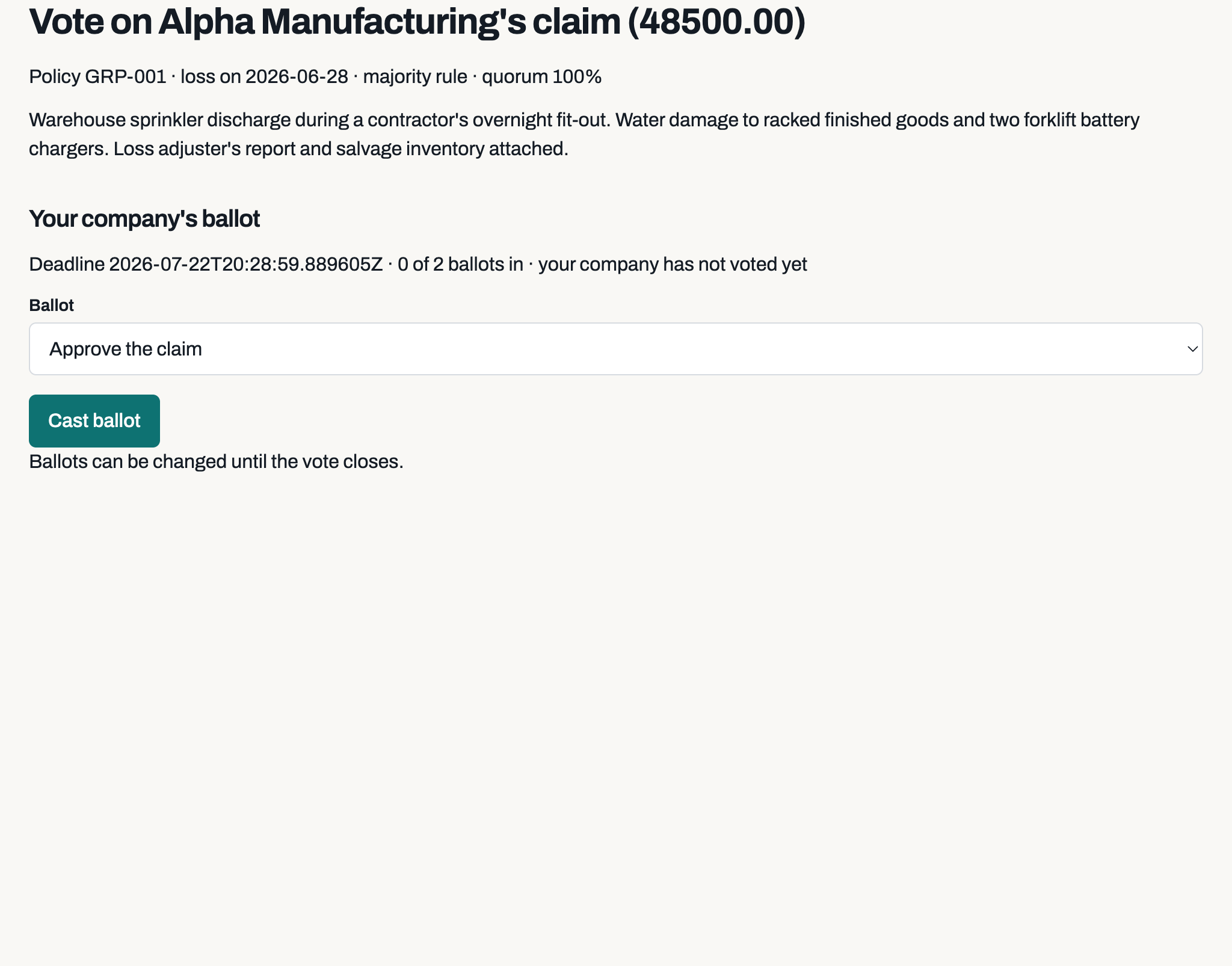
| A member voted on a claim | The ballot, the approval rule and quorum it was cast under, and the deadline it beat. |
| A claim was approved for an amount | Who decided, when, and the evidence that was attached at that moment — not the evidence attached since. |
| A payout was released | Both approvals, and the fact that neither person could have released it alone. |
The record proves itself
Every audit event is hashed when it is written and Merkle-batched onto a ledger. A member or a regulator can check the proof without taking your word for any of it — or your database's.
Members decide, on the record
Open a claim to a member vote with an approval rule, a quorum and a deadline. The claimant does not vote on their own claim. Every ballot lands in the same audit trail as everything else.
The whole captive, not a corner of it
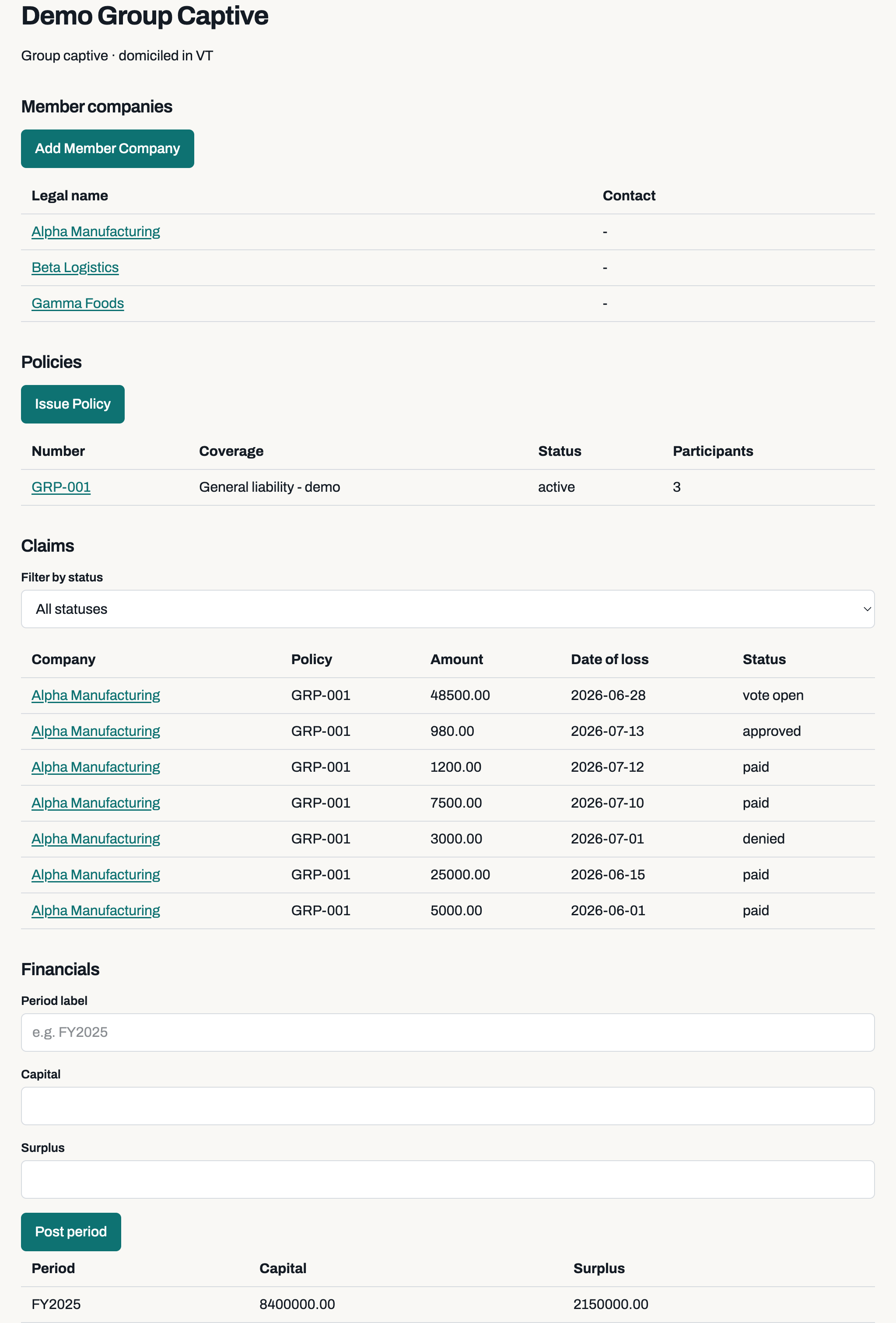
Member companies, policies and participants, claims through their full lifecycle, and posted financial periods — in one place, for group and single-parent captives alike.
Who this is not for
If you run a single-parent captive with one insured, no member voting and no history of disputes, most of what makes this different will not earn its keep. A policy administration system will serve you better and cost you less.
We do not prepare statutory filings, we do not do reinsurance treaty accounting, and we do not rate risks. If your bottleneck is producing annual returns across a dozen domiciles, this is not the tool that fixes it.
And it is early. There is no long customer list to point at and we are not going to invent one. What there is: a working platform you can run today, and an architecture that makes the record verifiable rather than merely asserted.
Bring a claim you argued about.
The fastest way to judge this is to walk a real decision through it — one you had to defend after the fact.
Request a demo